“Without memory, there is no culture. Without memory, there would be no civilization, no society, no future.”
Elie Wiesel
Yom HaZikaron laShoah ve-laG’vurah (יום הזיכרון לשואה ולגבורה; “Holocaust and Heroism Remembrance Day”), known colloquially in Israel and abroad as Yom HaShoah (יום השואה) and in English as Holocaust Remembrance Day, or Holocaust Day, is observed as Israel’s day of commemoration for the approximately six million Jews who perished in the Holocaust as a result of the actions carried out by Nazi Germany and its accessories, and for the Jewish resistance in that period. In Israel, it is a national memorial day.
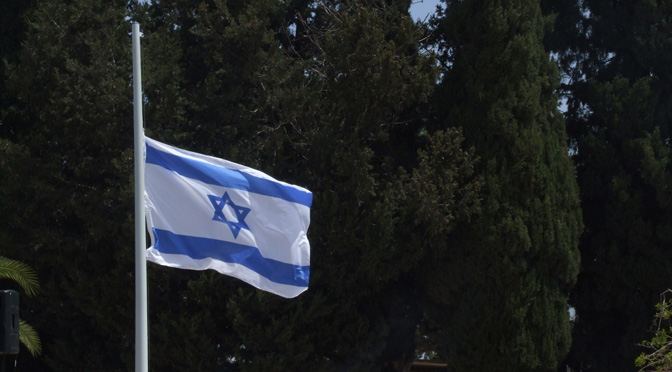
Yom HaShoah opens in Israel at sundown in a state ceremony held in Warsaw Ghetto Square at Yad Vashem, the Holocaust Martyrs’ and Heroes Authority, in Jerusalem. During the ceremony the national flag is lowered to half mast, the President and the Prime Minister both deliver speeches, Holocaust survivors light six torches symbolizing the approximately six million Jews who perished in the Holocaust and the Chief Rabbis recite prayers.
On Yom HaShoah, ceremonies and services are held at schools, military bases and by other public and community organizations.
On the eve of Yom HaShoah and the day itself, places of public entertainment are closed by law. Israeli television airs Holocaust documentaries and Holocaust-related talk shows, and low-key songs are played on the radio. Flags on public buildings are flown at half mast. At 10:00 a.m., an air raid siren sounds throughout the country and Israelis are expected to observe one minute of solemn reflection. Many people stop what they are doing, including motorists who stop their cars in the middle of the road, standing beside their vehicles in silence as the siren is sounded.
In the last few decades all the prayerbooks of Conservative, Reform and Reconstructionist Judaism have developed similar liturgies to be used on Yom HaShoah. The siddurim of these groups add passages that are meant to be added to standard weekday service, as well as stand-alone sections. These liturgies generally include:
Lighting of a candle (often each member of the congregation lights one)
Modern poems, including “I believe in the sun even when it is not shining…”
El Malei Rahamim (God, full of mercy, dwelling on high)
Y’hei sh’lama raba min sh’maya,
v’chayim aleinu v’al kol Yisrael.
V’imru: Amein.
Oseh shalom bimromav,
Hu yaaseh shalom aleinu,
v’al kol Yisrael. V’imru: Amein.
Exalted and hallowed be God’s great name
in the world which God created, according to plan.
May God’s majesty be revealed in the days of our lifetime
and the life of all Israel — speedily, imminently, to which we say Amein.
Blessed be God’s great name to all eternity.
Blessed, praised, honored, exalted, extolled, glorified, adored, and lauded
be the name of the Holy Blessed One, beyond all earthly words and songs of blessing,
praise, and comfort. To which we say Amein.
May there be abundant peace from heaven, and life, for us and all Israel,
to which we say Amein.
May the One who creates harmony on high, bring peace to us and to all Israel.
To which we say Amein.